
Your shift is almost over. Then a fight breaks out in the lobby, or someone slips on a wet floor, or a car alarm goes off in the garage and you find a smashed window. You handle it. Then your supervisor says the words every new guard dreads: “Write it up.”
Here’s the thing. The way you handle an incident matters, but the way you write it down matters just as much. Your report might be read by your client, the police, an insurance adjuster or a lawyer, sometimes months later. A clear report protects you, your company and the people involved. A sloppy one can undo all your good work.
The good news? Writing a strong incident report isn’t hard once you know the formula.
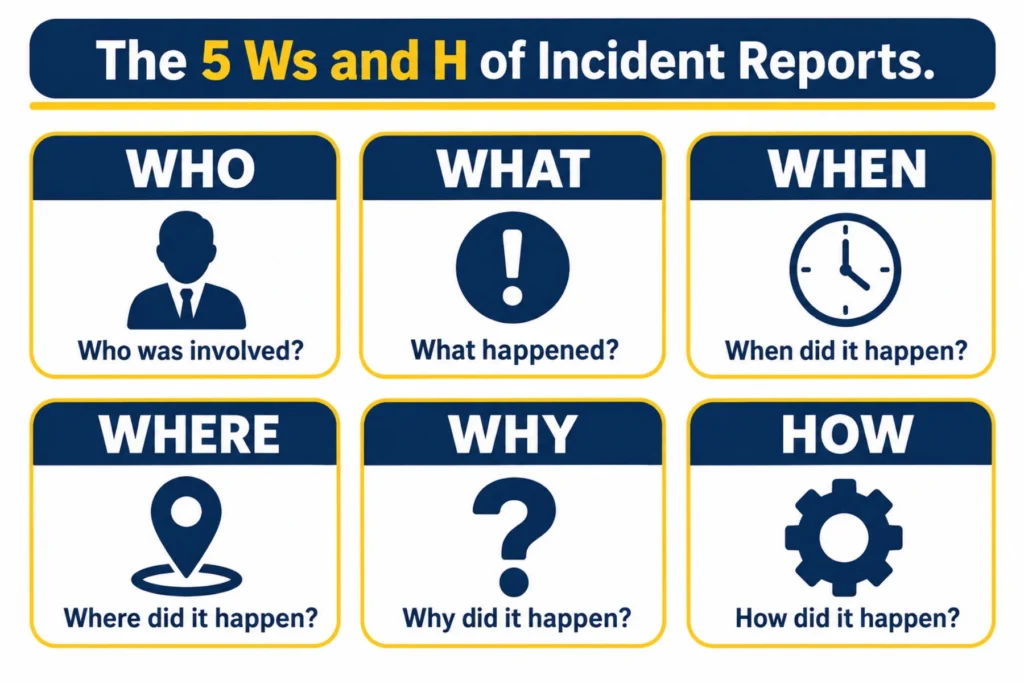
Quick answer: To write a security incident report, answer the 5 Ws and H: who, what, when, where, why and how. Write in first person and past tense, stick to facts you saw or heard, and record everything in the order it happened. Include names, exact times, actions taken and who was notified. Keep opinions out. Write it as soon as possible, while details are fresh.
What Is a Security Incident Report?
Short answer: It’s a written, factual record of an unusual event a security guard saw or handled on duty, like a theft, injury, fight, trespass or property damage.
Think of it as the official memory of what happened. It’s different from your daily activity report (DAR), which logs your routine patrols and checks. An incident report is for anything out of the ordinary.
Guards usually write incident reports for things like:
- Theft, shoplifting or attempted break-ins
- Injuries, slips, falls or medical emergencies
- Fights, threats or aggressive behavior
- Trespassing or refusing to leave
- Property damage, vandalism or fire alarms
- Suspicious people, packages or vehicles
If you’re not sure whether something needs a report, write one. A report nobody needed is better than a missing report everybody needs later.
Why do incident reports matter so much?
Short answer: Because they become evidence. Police, insurers, courts and your client may rely on your report to decide what really happened.
A good report also protects you. If your actions are ever questioned, a clear, timely record of what you saw and did is your best defense. This matters a lot when a situation involves detaining someone, so every guard should understand a guard’s legal powers in NY before writing about one.
What Should a Security Incident Report Include?
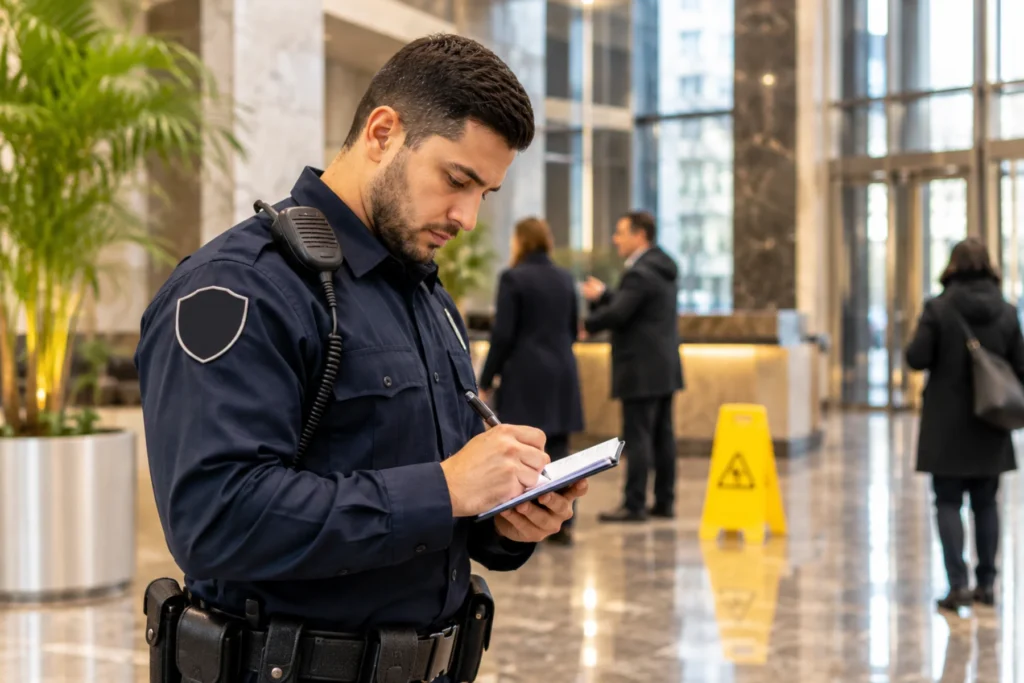
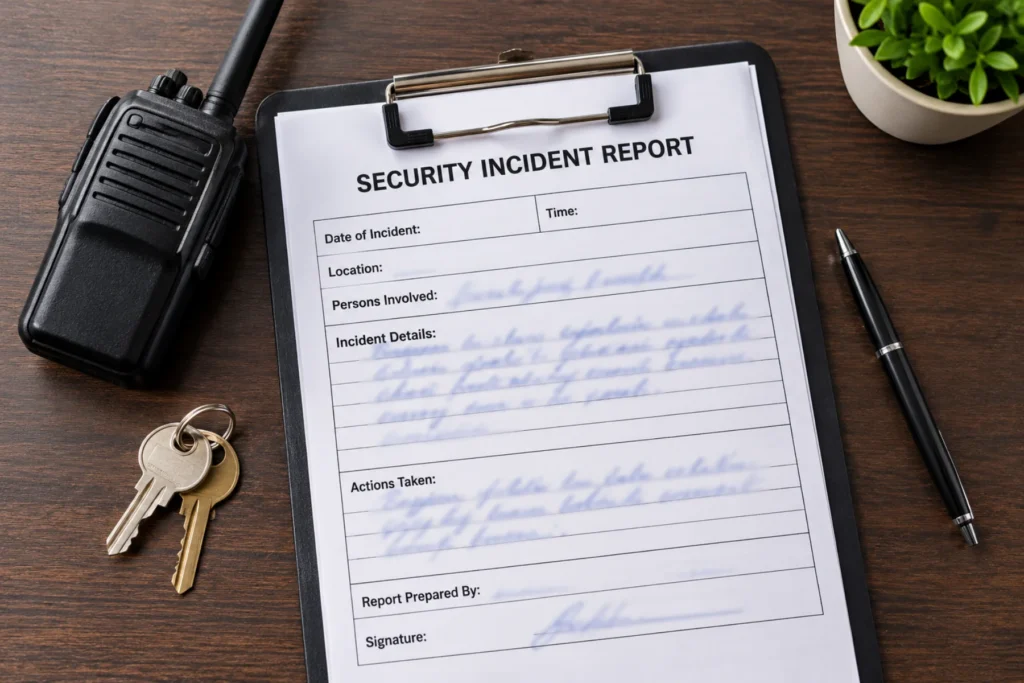
Short answer: The basic details (date, time, location), the people involved, a step-by-step account of what happened, what you did, who you notified and any evidence.
Use this checklist every time:
| Section | What to write |
|---|---|
| Report details | Report number, your name, badge or registration number, site, post |
| Date and time | When it happened and when you wrote the report (use exact times) |
| Location | Exact spot: floor, room, entrance, aisle, parking level |
| Type of incident | Theft, injury, trespass, fight, alarm, damage, other |
| People involved | Names, contact info and a physical description of anyone you couldn’t identify |
| Witnesses | Names and contact details, plus a short note of what each saw |
| Narrative | What happened, step by step, in the order it happened |
| Actions taken | What you did, and when |
| Notifications | Supervisor, police (with officer names and badge numbers), EMS, client |
| Evidence | Photos, CCTV camera numbers and times, items recovered |
| Signature | Your signature, plus your supervisor’s after review |
How to Write a Security Incident Report: Step by Step
Short answer: Collect the facts, fill in the basics, write the narrative in time order, add actions and notifications, attach evidence, then proofread before you submit.
Step 1: Take notes right away
Short answer: Jot down key facts in your notebook or phone the moment the scene is safe.
Times, names, plate numbers, what people said. Memory fades fast, especially after a stressful event. Short notes now make the full report easy later.
Step 2: Fill in the basic details
Short answer: Date, time, exact location, incident type and your information.
These look simple, but a wrong time or vague location (“in the building”) can make a report useless. Be specific: “Lobby, main entrance, near the east turnstiles.”
Step 3: Write the narrative in the order it happened
Short answer: Tell the story from start to finish, in first person and past tense.
Start with what first got your attention, then walk through each step with times. For example: “At 2:14 p.m., I observed a male near the north stairwell…” Use “I observed,” “I heard,” and “I asked.” Don’t skip ahead or jump back.
Step 4: Stick to facts, not opinions
Short answer: Write what you saw and heard, not what you think or assume.
Instead of “He was drunk,” write “He was unsteady on his feet, his speech was slurred and I smelled alcohol.” Instead of “She was being difficult,” write exactly what she said and did. If you quote someone, use their exact words in quotation marks.
Step 5: Record your actions and who you notified
Short answer: List what you did, when, and every person or agency you contacted.
Include the time you called your supervisor, 911 or EMS, and the names and badge numbers of responding officers. If you gave first aid, describe exactly what you did.
Step 6: Add evidence
Short answer: Note photos, CCTV camera numbers, recovered items and witness statements.
Write where the evidence is stored and who has it. If you hand an item to police, record the time, the officer’s name and what you handed over.
Step 7: Proofread and submit
Short answer: Read it once more for accuracy, spelling and clarity, then sign and submit it on time.
Ask yourself: could a stranger who wasn’t there understand exactly what happened? If not, add detail. Never change a report after you submit it. If you remember something new, write a supplemental report.
Security Incident Report Example (Filled-In Sample)
Short answer: Below is a realistic security guard incident report for a shoplifting stop. Notice the exact times, plain facts, first-person voice and clear list of actions.
Sample only. Names, places and numbers are made up.
| Field | Entry |
|---|---|
| Report # | 2026-1208-014 |
| Officer | J. Rivera, Security Officer, Post 2 |
| Site | Midtown retail store, 5th Avenue, New York, NY |
| Date / time of incident | December 8, 2026, 3:42 p.m. |
| Report written | December 8, 2026, 4:35 p.m. |
| Incident type | Theft (shoplifting) |
| Location | Aisle 6 (electronics) and front exit |
| Subject | Adult male, about 30, 5’10”, black hooded jacket, gray jeans, red backpack |
| Witness | M. Chen, store associate, ext. 214 |
| Evidence | CCTV cameras 6 and 11, 3:40 to 3:47 p.m.; recovered wireless earbuds (SKU 44821) |
Narrative:
At 3:42 p.m., while on foot patrol, I observed the subject in Aisle 6 remove a pair of wireless earbuds from the display, take the product out of its box and place it in the front pocket of his red backpack. He left the empty box on the shelf.
At 3:45 p.m., the subject walked past all open registers without paying and approached the front exit. I approached him inside the store, identified myself as store security and said, “Sir, I need to speak with you about the item in your backpack.”
The subject stopped and said, “I forgot to pay.” He removed the earbuds from his backpack and handed them to me at 3:46 p.m. I did not touch the subject or his backpack.
At 3:47 p.m., I notified my supervisor, Sgt. L. Brooks, by radio. Per store policy, the store manager, A. Patel, decided not to call police. The subject left the store at 3:52 p.m. I returned the earbuds to A. Patel at 3:55 p.m. and requested that CCTV footage from cameras 6 and 11 be saved.
Actions taken: Observed theft, made contact, recovered merchandise, notified supervisor, preserved CCTV.
Notifications: Sgt. L. Brooks (3:47 p.m.), Store Manager A. Patel (3:48 p.m.).
Signature: J. Rivera · Reviewed by: Sgt. L. Brooks
Common Mistakes That Get Incident Reports Thrown Out
Short answer: Opinions, vague times, missing names, slang, late reports and changing details after the fact.
These are the mistakes supervisors and lawyers spot right away:
- Opinions and guesses. “He looked guilty” isn’t a fact. Describe what you saw.
- Vague times and places. “Around lunchtime” and “near the front” don’t hold up. Use exact times and locations.
- Missing people. Every witness, officer and person involved needs a name or a clear description.
- Slang, codes and abbreviations. Not everyone knows your site’s radio codes. Spell things out.
- Writing it too late. The longer you wait, the more details you lose, and the less credible the report looks.
- Editing after submission. Never change a submitted report. Write a supplemental report instead.
- Leaving out what you did. If your own actions aren’t documented, it can look like you did nothing, or something wrong.
Free Security Incident Report Template
Short answer: Download our free, printable incident report template so you never miss a key detail on shift.
The template includes these fields:
- Report number, officer name, registration number, site and post
- Date and time of incident, and time the report was written
- Exact location and type of incident
- People involved (names, descriptions, contact info)
- Witnesses (names, contact info, what they saw)
- Narrative (lined space, in time order)
- Actions taken and times
- Notifications (supervisor, police, EMS, client), with names and badge numbers
- Evidence (photos, CCTV camera numbers, items recovered)
- Officer signature and supervisor review
Print a few copies for your clipboard, or save the PDF to your phone.
How KTI Training Helps You Write Better Reports
Short answer: New York requires every guard to complete state-approved training, and KTI’s courses teach practical skills like observation and report writing using real NYC scenarios.
Under the New York Department of State’s security guard training requirements, every guard completes an 8-hour pre-assignment course, 16 hours of on-the-job training within 90 days of starting work, and 8 hours of in-service training every year.
At Knight Training Institute, our 16-hour on-the-job training goes deeper into real situations guards face every day, including how to document them. Already working? Our annual in-service refresher keeps your skills sharp and your registration current.
Report writing is just one part of the job. If you’re new to security, here’s a closer look at daily security guard duties. And if you manage a building or business, our emergency action plan training helps your whole team respond and document emergencies the right way.
Frequently Asked Questions
What are the 5 Ws of an incident report?
The 5 Ws are who, what, when, where and why, plus how. Who was involved, what happened, when it happened, where it happened, why it happened (if known from facts) and how it happened or was resolved. Answering all six makes your report complete.
Should an incident report be written in first person?
Yes. Security incident reports are written in first person and past tense, for example, “I observed” and “I called.” It makes clear what you personally saw and did, which is what readers need.
How soon should a security guard write an incident report?
As soon as the scene is safe and before your shift ends, if possible. Take quick notes right away, then write the full report while details are fresh. Many sites require reports before you leave your post.
What is the difference between an incident report and a daily activity report?
A daily activity report (DAR) logs your routine shift: patrols, checks and normal events. An incident report covers one unusual event, like a theft, injury or fight, in full detail.
Can an incident report be used in court?
Yes. Incident reports can be used by police, insurance companies and attorneys, and they can come up in court. That’s why accuracy, facts and clear times matter so much.
What should you never put in an incident report?
Personal opinions, guesses about motives, jokes, slang, insults or anything you didn’t see or hear yourself. If someone told you something, write it as what they said, not as fact.
Can I change an incident report after I submit it?
No. Once submitted, don’t edit the original. If you remember new details or find a mistake, write a supplemental report that references the original report number.
Want to become a security guard in NYC? Knight Training Institute offers NYS-approved 8-hour, 16-hour and annual courses, live online over Zoom. Call 646-867-1144 or register for your course today.